

Meditation And Flow: Get In The Zone
If you want to get in the zone and experience flow state, meditation is the key. In this guide, I’ll share the secrets pro athletes use to “lock in” and enter flow—plus a special guided meditation to help you experience it for yourself today.
What Is Flow State?
Flow is the state of being fully immersed in an activity—completely focused yet relaxed. In my article on meditation for pro athletes, I discussed being “in the zone” or “locked in.” Flow state is the same: an optimal state for performance. Many of my clients seek my help in achieving this state through private meditation lessons.
Psychologist Mihály Csíkszentmihályi coined the term “flow” in 1975 after observing artists so immersed in their work that they ignored hunger, thirst, and fatigue.
The Six Core Aspects of Flow:
- Intense focus
- The merging of action and awareness
- Loss of self-consciousness
- A heightened sense of control
- Distorted sense of time
- An intrinsic sense of reward from the activity
For an activity to induce flow, it must:
- Have clear goals and progress markers
- Provide immediate feedback
- Strike a balance between challenge and skill—too easy, and it’s boring; too hard, and it’s stressful
Interestingly, Csíkszentmihályi found that people more prone to flow (“autotelic” individuals) are naturally curious, persistent, and less egotistical—traits also emphasized in Buddhist philosophy.
While flow is well known in sports and gaming, studies show it also improves workplace productivity, learning, and overall life satisfaction. Plus, flow triggers a dopamine release, making it an inherently pleasurable experience. The question is: how do you access it? The answer: meditation.
Meditation And Flow State
Meditation helps induce flow by reducing self-referential thinking, worry, and anxiety—common blockers to the state.
Seventeen studies involving over 10,000 participants found a strong correlation between mindfulness and flow. Here’s why:
Before meditation, the mind is noisy—full of distractions, doubts, and stress. These mental interferences make flow difficult. But as we meditate, we quiet the mind.
For example, focusing on the breath (as in Samatha or Dharana meditation) reduces mental chatter and increases concentration. Over time, we reach states of deep absorption (Dhyana), where focus is effortless. This mirrors the flow state: complete immersion, minimal self-consciousness, and an intrinsic sense of ease.
At higher levels, meditation leads to Samyama—a state of sustained oneness with the meditation object. This is essentially flow but within meditation itself.
Meditation + Action = Flow
While meditation builds focus, flow also requires action. That’s where mindfulness activities come in—performing any task with full, present-moment awareness.
By combining focused meditation with mindful action, we train the mind to enter flow naturally and consistently.
Now, let’s experience it for ourselves.
Guided Meditation For Flow

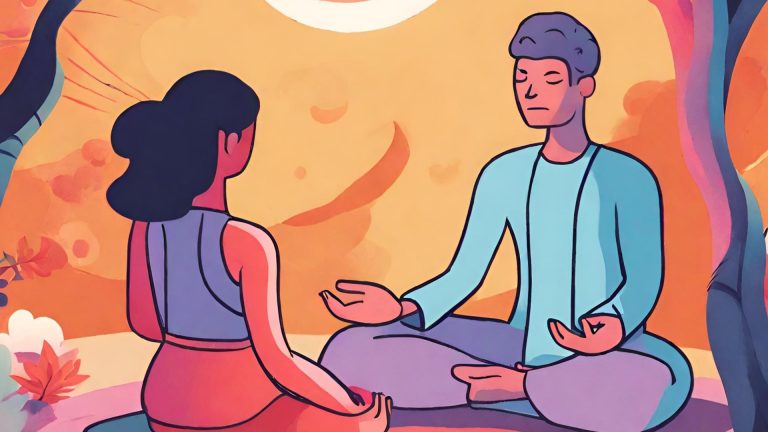
- Find a comfortable seated position. Keep your back straight, shoulders relaxed, and feet grounded. Close your eyes.
- Breathe deeply. Inhale through your nose for four counts, hold for four, exhale for four, and pause for four. Repeat.
- Focus on the “Moustache Space.” This is the area just beneath your nose where you feel the breath passing. Stay here.
- Observe your thoughts. Notice any distractions—thoughts, emotions, sounds—and label them (“thinking,” “feeling,” “hearing”), then return to your breath.
- Continue for ten minutes. Let focus deepen naturally.
- Slowly open your eyes. Keep your gaze steady. Observe without moving.
- Mindful movement. Slowly raise your arms above your head over ten seconds, hold for ten, then lower for ten. Repeat three times.
- Apply it. Choose an activity—writing, playing an instrument, running—and do it with the same focused awareness you cultivated in meditation.
Other Ways to Enter Flow
- Commit to focused attention. Studies show it takes 10–15 minutes of deep focus to enter flow.
- Set clear goals. Csíkszentmihályi found that structured tasks with defined objectives make flow more accessible.
- Eliminate distractions. Either reduce them externally or train your mind to ignore them with meditation.
- Find the right challenge. Flow occurs when a task is difficult enough to engage but not so hard it induces anxiety.
- Use meditation and mindfulness. The more you practice, the more easily you’ll slip into flow.
How Flow Affects Your Brain
Research suggests two main theories:
- Transient Hypofrontality Hypothesis: Flow reduces activity in the prefrontal cortex (which governs self-consciousness and memory). Meditation similarly quiets this region, explaining their connection.
- Synchronization Theory: Flow improves neural communication, making the brain more efficient. Meditation also enhances brain synchronization, reinforcing the link between the two.
Summary
Flow is an optimal state for peak performance—whether in sports, gaming, art, or work. It’s complete engagement without anxiety or self-consciousness. And meditation is the best way to access it.
Practice the meditation above daily, and you’ll start experiencing flow more often. For deeper results, book a private meditation session with me. Let’s unlock your full potential together.

Paul Harrison is a meditation teacher with 25 years of experience and a deep passion for helping others. Known for his empathy and authentic approach, he’s dedicated to guiding individuals and teams toward mindfulness, clarity, and well-being.




I really resonate with your point about flow being complete engagement without self-consciousness – that’s exactly what I work toward with my sound healing clients. I’ve been experimenting with Quantress as a pre-session tool lately, and the archetype-based audio design has genuinely helped clients drop into that coherent state faster than before. Have you noticed any practices that shift you into flow most reliably?